
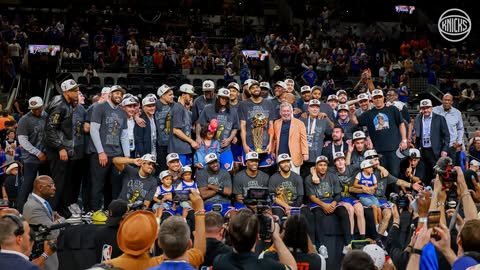
For the first time since 1973, the New York Knicks are champions of the NBA. On Saturday night in San Antonio, New York beat the Spurs 94–90 to close out the 2026 Finals in five games, ending the longest title drought of any Original-team franchise and validating a roster, a coach, and a fan base that had spent decades being told it wasn’t quite enough.
It is the third championship in franchise history — joining the 1970 and 1973 teams that have lived in highlight reels and the memories of an aging generation — and the first that today’s Madison Square Garden crowd can call its own.
If a screenwriter had pitched this Finals, it would have been rejected for being too on-the-nose. The Knicks won the series 4–1, and in every single one of those five games they trailed by double digits before clawing back. The Spurs, behind their young core, came out of the gate ferocious in each contest — San Antonio won the first quarter of all five games by a combined 57 points — and New York simply refused to be buried.
The defining performance came in Game 4 at the Garden, where the Knicks erased a 29-point halftime deficit to win 107–106, the largest comeback in NBA playoff history. By the time Game 5 arrived, the pattern was almost expected: New York fell behind, weathered the early storm, and surged in the second half to take the title.
The numbers underscore just how rare this was. According to the league’s three decades of play-by-play data, the 2026 Finals was the only championship series on record in which every game was decided within five points in the final five minutes. New York’s playoff record in games where it trailed by double digits — 6–2 — stands as the best of any team across those thirty years, a stretch in which teams overall won barely one in five such games.
Jalen Brunson was named Finals MVP, capping a postseason run that answered every lingering question about whether a 6-foot-2 guard could be the centerpiece of a champion. He poured in 45 points in the clincher, carrying New York through the stretches when the offense had nowhere else to turn.
For years the book on Brunson was that he was too small, too earthbound, too limited to anchor a title team. The 2026 playoffs rewrote it. His composure in late-game possessions — the ability to get to his spots, draw contact, and deliver in the final two minutes — became the throughline of a series where almost every game came down to the wire.
A roster built by trade, not by tank
What makes this title distinct is how it was assembled. The two most recent champions before them — Oklahoma City in 2025 and Boston in 2024 — were built patiently through the draft, the model most of the modern league is designed around. The Knicks went the other direction.
Only reserves Mitchell Robinson and Miles McBride were drafted by New York. The rest of the rotation arrived through aggressive dealing: Josh Hart, Brunson’s old college teammate, came over in 2023; OG Anunoby was pried loose in a long-rumored move in late 2023; and Karl-Anthony Towns arrived in a blockbuster that gave the front line the scoring big it needed. Team president Leon Rose bet that he could trade his way into contention rather than wait out a rebuild, and the bet paid off in full.
Coach Mike Brown deserves his own paragraph in this story. Fired four times across his career and frequently overlooked despite his résumé, Brown guided a roster that had broken down in back-to-back playoff runs and finally got it to merge a modern, top-five offense with an old-school, grind-it-out playoff identity.
New York’s path to the Finals was its most dominant postseason march in a generation. The Knicks dispatched the Atlanta Hawks in the first round, then swept the Philadelphia 76ers and the Cleveland Cavaliers in the following two rounds — reaching the Finals for the first time since 1999 and stringing together eleven straight playoff wins, only the fifth team in league history to do so.
The Finals itself was a rematch on two fronts. It echoed the 1999 Finals, when the Spurs beat the Knicks in five for the first title in San Antonio’s history, and it was a do-over of the 2025 NBA Cup final, which New York had already won. This time the Knicks finished the job.
None of this diminishes San Antonio. The Spurs, led by Victor Wembanyama and De’Aaron Fox under coach Mitch Johnson, knocked off a juggernaut to even get here — they beat the defending-champion Thunder in a seven-game Western Conference finals after Oklahoma City had opened the playoffs 8–0. Wembanyama was a force throughout the series, and the Spurs’ fast starts repeatedly put New York on the ropes. They simply couldn’t close, and Johnson said as much afterward, acknowledging that his team did plenty of good things but failed to finish.
San Antonio’s youth suggests these two may meet again. For now, though, the Spurs are the team that pushed a champion to the brink in nearly every game and still came up short.
The 2026 Finals averaged more than 20 million viewers on ABC and ESPN, capping the most-watched NBA postseason since 1998 — a reminder of what a deep New York playoff run does for the league’s national footprint. It also marked the eighth consecutive season with a different champion, the longest such run in NBA history.
But the lasting image won’t be a ratings chart. It will be Brunson with the ball in the final minutes, a Garden-bred roster refusing to fold, and a city that waited fifty-three years finally exhaling. The Knicks are champions again. After half a century of “next year,” next year is here.